
The calibration signal on the EEG recording apparatus checks the components of the machine before a biological signal has entered the amplifiers. The apparatus should also be checked once the biological signal has entered the system.
Biological calibration
Biological calibration traditionally was the process of recording the same signal on each channel to ensure each amplifier and pen reacted in the same way to the changing signals at the output.
Digital recorders do not allow a true representation of individual amplifiers with the same inputs, instead the digital apparatus simply duplicates the one channel a number of times. The benefits of biological calibration on the digital system are limited to ensuring a biological signal is able to be recorded, albeit from one electrode pair only.
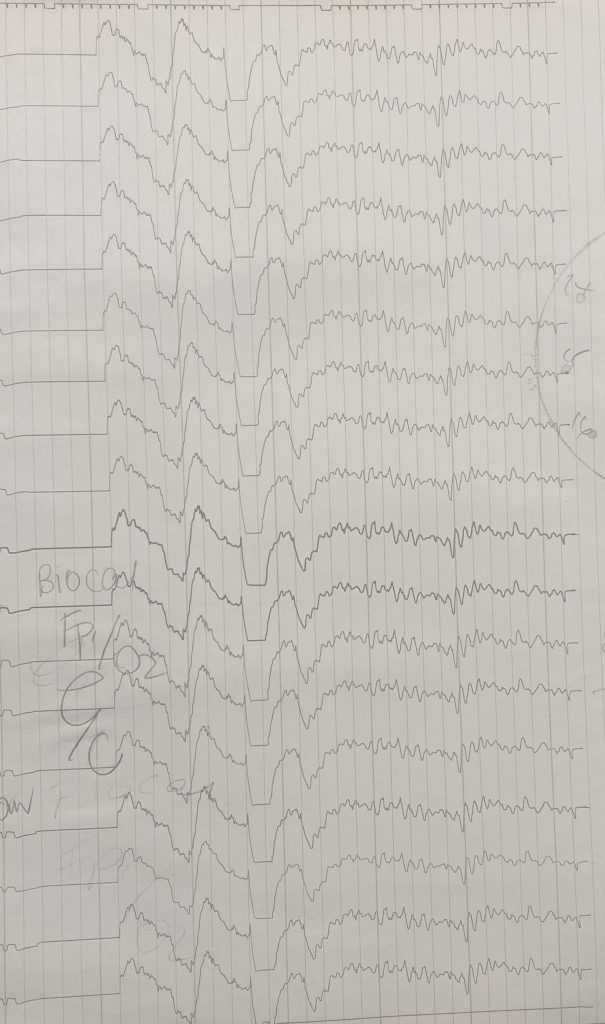
The above diagram is an example of a Biological Calibration on an analogue recording apparatus, where each individual amplifier is connected to the same pair of electrodes. In this case Fp1 – O2. It can be seen that each individual pen mechanically reacts almost identically to the same electrode pair input. If a difference was noticed in any channel, the pen/galvanometer was adjusted accordingly.
All electrode check
An alternative to biological calibration would be to perform an ‘all electrode check’, displaying all active electrodes in referential or common reference mode for a period of say 10 to 20 seconds. This allows the scientist/technologist to be sure that all electrodes applied to the head function well at the beginning of the recording before moving to another montage where only a selection of all the electrodes are viewed at any one time.
For example, in an anterior to posterior serial bipolar montage you would not typically include the mastoid electrodes. If one of the mastoid electrodes was not recording well you may not notice this until a montage including those electrodes was in use. If that were the case, a portion of the recorded signal would include a poorly functioning mastoid electrode and may limit reviewing choices on replay.
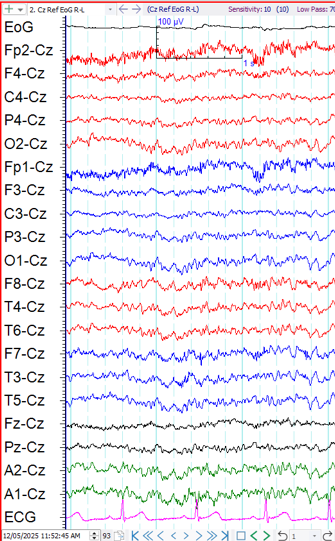
Above is an example of a montage showing all available electrodes referred to a common reference Cz.
