
The routine calibration is a brief overview of how the EEG recorder is functioning. Even though digital EEG recording systems are calibrated within the software and are very unlikely to alter, it is still important to know the machine settings match what they claim.
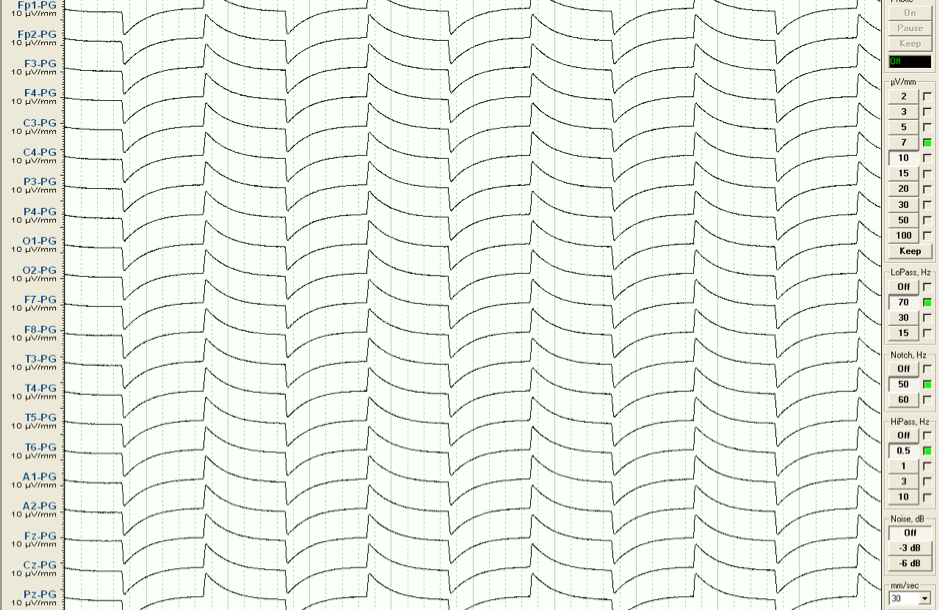
The above picture is an example of a typical calibration display that should be recorded at the beginning and the end of an EEG on a digital recording apparatus.
The calibration signal defines the recording characteristics and how the EEG waveforms are presented on screen. By viewing the calibration signal we get an idea of size (amplitude), signals available (filters), speed of the signals presenting (frequency), and timing of the signals (alignment). We can also determine if the signals presented are within the display range (centering). The machine parameters that influence the display of these characteristics are sensitivity, display speed and the high and low frequency filters.
